4 The Standard Deduction and Itemized Deductions
Question for this chapter. Which reduces tax more, the standard deduction or itemized deductions? The law changed and the standard deduction went up. What does that mean for your household? Is there an extra deduction for older filers?
Short answer. You do not use both. The basic structure is to pick the larger of the two. For the 2025 tax year, the standard deduction for a single filer is $15,750. That is higher than the value before the law change. So the first check is whether your itemized total is larger than this amount. Filers aged 65 or older get an additional amount added to the standard deduction. A new senior deduction also started in 2025. The new deduction has eligibility rules and an income threshold, so the result depends on the household's filing status and income.
4.0 Names and rules
U.S. federal income tax is worked out roughly in this order:
- Add up the year's income to get adjusted gross income.
- Subtract deductions to get taxable income.
- Look up the tax for that taxable income.
This chapter covers the middle step: what you subtract, and how much.
Term box — Standard deduction. A fixed amount, set by filing status, that you subtract from income. It does not depend on what you actually spent. On the return it is handled near line 12e of Form 1040 (Form 1040 Instructions 2025).
Term box — Itemized deductions. A deduction built by adding up amounts you actually paid for specific items. Examples are state and local taxes, and medical expenses above a set floor. You choose this instead of the standard deduction.
Term box — Adjusted gross income (AGI) and modified adjusted gross income (MAGI). AGI is the year's income after certain adjustments. MAGI is AGI with specific items added back or removed. Each rule defines its own MAGI. The income level at which a deduction starts to shrink is usually set in terms of MAGI.
Term box — Taxable income. What remains after you subtract deductions from AGI. The tax is looked up from this amount.
Term box — Tax Table. A table that lists the tax for each band of taxable income. If taxable income is under $100,000, you look up the tax in this table.
This chapter keeps three things separate:
- The amount a deduction removes from taxable income.
- The tax that goes down as a result. On the return, this final tax is compared with what was already paid during the year. That comparison gives the settlement difference: tax still owed, or an overpayment.
- The money that actually reaches your bank account as a refund.
A refund depends on the gap between tax withheld during the year and the final tax. A bigger deduction does not mean a refund of the same size. Chapter 1 explains the basic idea of this gap. Chapter 8 explains how to read the withholding amounts on your documents.
This book does not prepare your return. It lists deductions you may have missed, with the rule and the assumptions behind each one, so you can check them. The book's values are 2025 tax-year values. The status label next to each value shows whether that transcribed value has been checked against the official document.
4.1 Standard deduction amounts and the 2025 law change
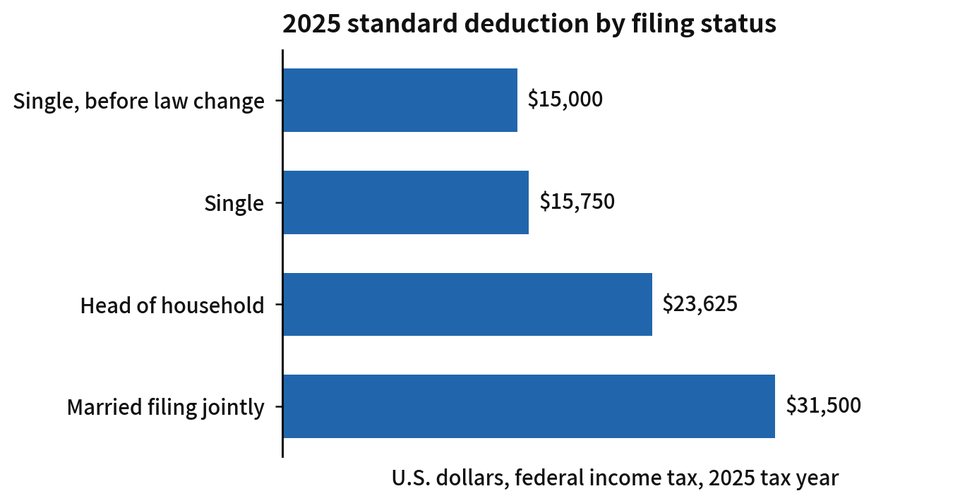
Figure 4-1. The single standard deduction rose from $15,000 before the law change to $15,750. Head of household is $23,625 and married filing jointly is $31,500.
Amounts by filing status
The standard deduction depends on filing status. This chapter covers three filing statuses.
| Filing status | 2025 standard deduction |
|---|---|
| Single | $15,750 |
| Married filing jointly (MFJ) | $31,500 |
| Head of household (HOH) | $23,625 |
The married-filing-jointly amount is twice the single amount. The head-of-household amount is larger than single and smaller than married filing jointly. Whether a filer can use head of household depends on separate requirements. Chapter 5 covers those requirements and the rules on dependents.
The value went up with the law change
The 2025 tax-year values were first published in Rev. Proc. 2024-40. At that point the single standard deduction was $15,000. Later, Pub. L. 119-21 (the 2025 law change) changed this value. The single standard deduction is now $15,750, which is larger than before the change.
This has two effects:
- Households that itemized before. A larger standard deduction raises the bar that itemized deductions must clear. A household that itemized because its total was slightly larger may now find the standard deduction is the larger one.
- Households that already used the standard deduction. Their taxable income goes down a little at the same income.
If you used material or software released early in the year, check which value it was based on. It may still show the value from before the change.
When someone else can claim you as a dependent
A person who is someone else's dependent works out the standard deduction differently. An example is a child listed on a parent's return. This calculation has a minimum amount of $1,350. It also includes a step that adds $450 to the person's own earned income. Use the standard deduction worksheet in the Form 1040 Instructions to find the actual standard deduction. Chapter 5 covers who counts as a dependent.
Assumption. The table above is for federal income tax. State income tax standard deductions vary by state. This chapter does not cover them.
How to read it. You need your filing status before you can pick the standard deduction amount. The same household can start the comparison below from a different point depending on the filing status it uses.
4.2 Comparing with itemized deductions
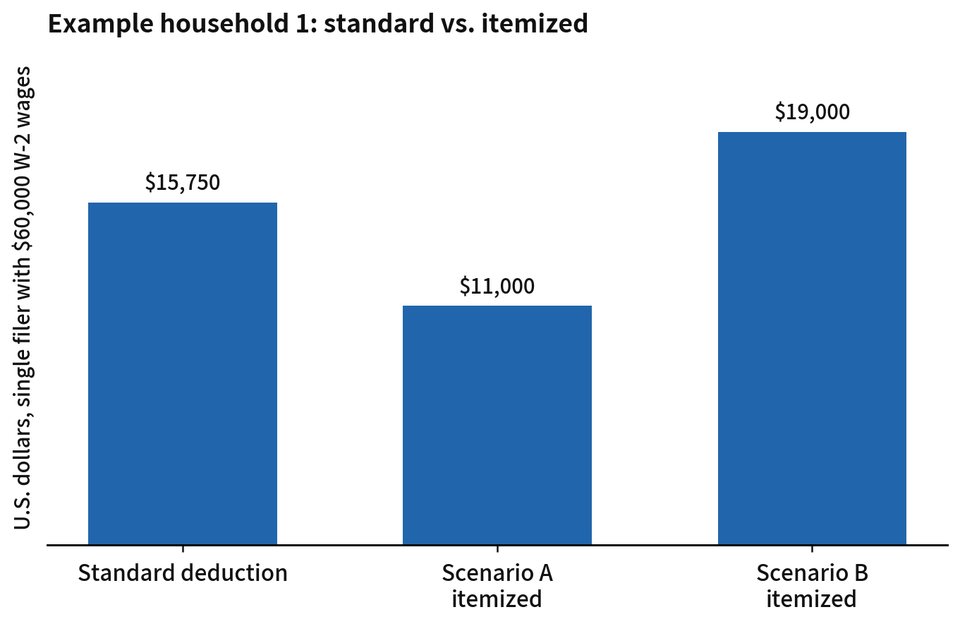
Figure 4-2. Scenario A's $11,000 is below the standard deduction, so the standard deduction is used. Scenario B is $3,250 larger, and tax goes from $5,075 to $4,685, a $390 reduction.
The basic comparison
The rule is simple:
- If your itemized total is larger than the standard deduction, there is a reason to itemize.
- If it is smaller or equal, the standard deduction reduces taxable income more.
The hard part is adding up the itemized total correctly. Each item has its own limit or floor.
Two examples:
- Medical expenses. Only the part above 7.5% of AGI counts, not everything you spent.
- State and local taxes. These have a limit (section 4.3).
So the total of all your receipts can differ from the amount you can actually deduct.
Example household 1 — single filer, W-2 wages only
Example. This household files as single. Its only income is $60,000 in W-2 wages. We assume those wages are also its AGI. For the itemized total, the book uses just two assumed amounts. It does not say which items make up each total.
| Case | Deduction | Taxable income | Tax from Tax Table |
|---|---|---|---|
| Standard deduction | $15,750 | $44,250 | $5,075 |
| Scenario A itemized | $11,000 | (not chosen) | (not chosen) |
| Scenario B itemized | $19,000 | $41,000 | $4,685 |
With the standard deduction, taxable income is $44,250. That is under $100,000, so the tax comes from the Tax Table: $5,075. The marginal tax rate at this income is 12%.
Scenario A. An itemized total of $11,000 is smaller than the $15,750 standard deduction. The standard deduction reduces taxable income more, so there is no reason to itemize. Sorting receipts by item would not lower this household's federal tax.
Scenario B. An itemized total of $19,000 is $3,250 more than the standard deduction. Itemizing gives taxable income of $41,000. The Tax Table tax is $4,685. Compared with the standard deduction, tax goes down by $390.
Keep three numbers apart here:
- $3,250 is the extra amount removed by the deduction.
- $390 is the tax that goes down as a result.
- The refund depends on the withholding shown on this household's W-2. This example does not set a withholding amount, so it cannot give a refund amount.
Assumption. Wages equal AGI. Other income, tax credits and state income tax are left out. The itemized totals already reflect each item's limits and floors.
How to read it. The marginal rate is a rough guide to how much tax drops when a deduction grows a little. The Tax Table works in bands, so the deduction difference times the marginal rate may not match exactly. The firmer method is the one in the table: look up the tax for each case and compare. If your itemized total is close to the standard deduction, one small item can change the choice. In that case, go through the documents for each item again.
4.3 The limit on the state and local tax deduction
For many households thinking about itemizing, the largest items are usually state income tax and property tax. This item has a limit.
Term box — State and local tax (SALT) deduction. An itemized deduction for state and local income tax (or sales tax) and property tax paid during the year. It is allowed up to a set limit.
Basic limit and the high-income range
| Item | General | Married filing separately |
|---|---|---|
| Basic limit | $40,000 | $20,000 |
| MAGI at which the limit starts to shrink | $500,000 | $250,000 |
| Reduction rate on the excess over that MAGI | 30% | 30% |
| Lowest limit after reduction | $10,000 | $5,000 |
How to read the table:
- If MAGI is above the threshold, the limit shrinks by 30% of the excess.
- The limit never goes below the lowest limit.
- The limit is the most you can deduct. If you paid less than the limit in state and local taxes, you deduct only what you paid.
Example situation — high taxes paid, but the deduction stops at the limit
Example. Picture a household in a state with high income tax that also pays property tax.
- If the two taxes together are more than the $40,000 basic limit, the part above the limit does not count toward the itemized total.
- If the household's MAGI is above $500,000, the limit itself is smaller than the basic limit.
In both cases, the amount to use in the section 4.2 comparison is the amount after the limit, not the total tax paid.
Assumption. This example situation has no specific amounts. To see how the MAGI used for the reduction is worked out, check the relevant form and instructions (Schedule A instructions).
How to read it. If income received in your home country is included on the U.S. return, MAGI can go up. Check again whether that puts you in the range where the limit shrinks. This chapter does not cover where taxes paid to your home country go on the U.S. return.
4.4 Deductions for older filers — the additional standard deduction and the new senior deduction
People aged 65 or older have two separate deductions. Both use the same age to decide who counts as older, but they are different deductions.
First: the additional amount on the standard deduction
If you are 65 or older, or blind, the standard deduction goes up for each box that applies.
| Status | Additional amount per box |
|---|---|
| Married | $1,600 |
| Unmarried (single or head of household) | $2,000 |
The unmarried amount is larger than the married amount. If both age and blindness apply, that is two boxes. Check how many boxes apply using the checkboxes on Form 1040 and its instructions. This additional amount is part of the standard deduction. If you itemize, you do not get it.
Second: the new senior deduction that started in 2025
Term box — New senior deduction (the new deduction). A deduction created by Pub. L. 119-21 (the 2025 law change). It allows up to $6,000 extra for each qualifying person aged 65 or older. It is on a separate line from the standard deduction.
This deduction has an income threshold. The threshold is a MAGI of $75,000 for single and similar filers, and $150,000 for married filing jointly. Above the threshold, the deduction shrinks by 6% of the excess.
Example household 2 — single filer, older
Example. This household files as single. The filer is 67. W-2 wages are $60,000. As in example household 1, we assume the wages are both AGI and MAGI. The standard deduction is $17,750, including one additional-amount box. The new senior deduction is also claimed, on its own line.
| Item | Amount |
|---|---|
| Standard deduction (including one additional box) | $17,750 |
| Taxable income after also using the new deduction | $36,250 |
| Tax from Tax Table (with the new deduction) | $4,115 |
| Tax from Tax Table (without the new deduction) | $4,835 |
| Tax reduction from the new deduction | $720 |
This household's income of $60,000 is below the $75,000 threshold, so the new deduction does not shrink. With the new deduction, tax goes from $4,835 to $4,115. That is $720 less tax. This $720 is a reduction in tax, not a refund. A refund has to be worked out together with withholding, so this example does not give one.
Assumption. The filer is not blind and has no other income. The filer meets the Social Security number requirement (section 4.5). Other income, such as Social Security benefits, can change MAGI.
How to read it. Older households should check the two deductions separately:
- The additional standard deduction is inside the standard deduction.
- The new senior deduction is on its own line.
If you follow material prepared early in the year, or last year's return, you can miss the new line. Make it one of the items you check.
4.5 When a deduction does not apply
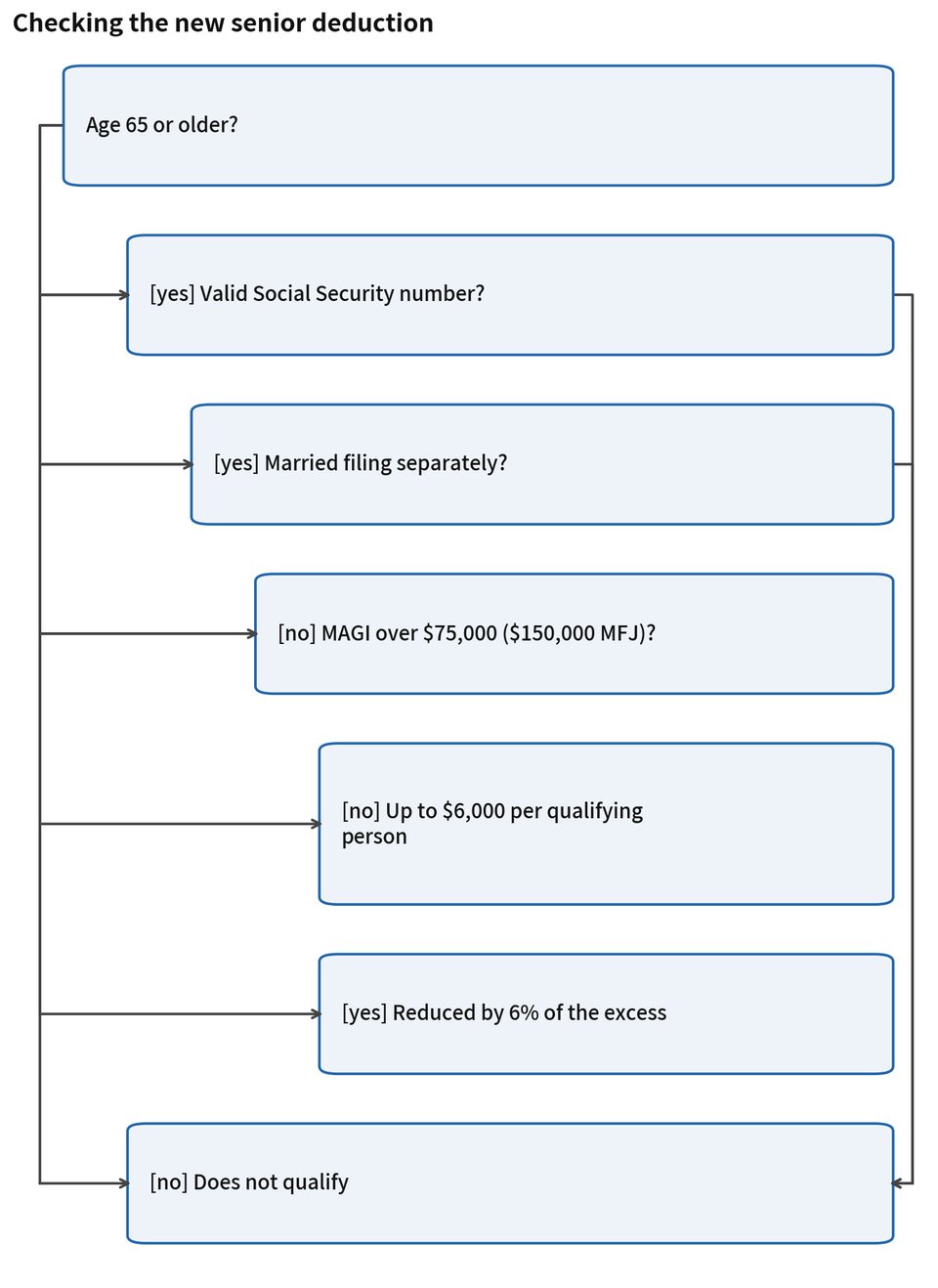
Figure 4-3. The new senior deduction checks age, Social Security number, filing status and income in turn. Above the income threshold it shrinks by 6% of the excess.
Who does not qualify
New senior deduction.
- A valid Social Security number is required. If a household has only another type of taxpayer number, check this requirement in the instructions.
- Married couples who file separately (married filing separately) cannot use this deduction.
- If MAGI is above the threshold ($75,000, or $150,000 for married filing jointly), the deduction shrinks by 6% of the excess. At high enough income, check the instructions to see what the reduction leaves.
- A filer under 65 does not qualify. This chapter does not cover which date is used to decide age.
Additional standard deduction.
- It is part of the standard deduction. If you itemize, you do not get it.
- A filer who is under the age threshold and not blind has no box.
State and local tax deduction.
- It is used only when you itemize.
- Any amount above the basic limit is not deductible.
- In the high-income range, the limit can shrink as low as the lowest limit ($10,000, or $5,000 for married filing separately).
The standard deduction itself.
- A filer who is someone else's dependent uses the separate calculation in section 4.1, not the regular amount.
- Other cases where the standard deduction is not allowed or is a different amount, such as a spouse's choice or residency status, are not covered in this chapter.
FAQ
Question. I itemized last year. Can I just do the same this year? Answer. This year the standard deduction is higher than the value before the law change. So the same items can give a different result this year. Add up your itemized total again and compare it with $15,750 (single).
Question. If I get the senior deduction, does my refund go up by the same amount? Answer. The new deduction lowers taxable income, and that lowers tax. The actual refund depends on the gap between tax withheld and the final tax. So you cannot say it equals the tax reduction. See Chapter 1 and Chapter 8 for this difference.
Question. What if I missed one of these deductions on last year's return? Answer. Correcting a past year uses an amended return (1040-X). That is a separate process with a time limit. This chapter does not cover it.
What this comparison shows
The two scenarios in example household 1 show what matters for itemizing. The question is not whether you have itemized deductions at all. It is whether they are larger than the standard deduction. In a year when the standard deduction goes up, that bar goes up too.
Example household 2 shows that for older households, two things each lower tax:
- the additional amount on the standard deduction
- the new deduction on its own line
So check each one separately.
Limits of this chapter
- The itemized totals in the examples are amounts the book assumed. The actual items are not specified. A real household's total is known only after rules such as the state and local tax limit and the medical expense floor are applied.
- All examples are single filers, and they assume wages equal both AGI and MAGI. For married filing jointly, head of household, or households with home-country income, the starting point and the thresholds are different.
- Withholding is not included, so these examples cannot show a refund or a balance due.
- State income tax, tax credits and dependent-related calculations are left out of the comparison.
- Some details must be checked in the relevant forms and instructions: the new deduction's finer eligibility rules (the date used to decide age, the items in MAGI) and the MAGI calculation for the state and local tax limit.
What is confirmed / What cannot be decided yet / Information you need
What is confirmed
- The 2025 standard deduction is $15,750 for single, $31,500 for married filing jointly and $23,625 for head of household. The single amount is higher than the $15,000 before the law change (Rev. Proc. 2024-40, Pub. L. 119-21).
- In example household 1, the standard deduction is larger in Scenario A. In Scenario B, itemized deductions are $3,250 larger, and tax goes down by $390.
- In example household 2, income is below the threshold, so the new deduction does not shrink. Tax goes down by $720.
- The new deduction requires a valid Social Security number. It cannot be used when filing married filing separately. It shrinks when income is above the threshold.
- The state and local tax deduction has a basic limit, a high-income reduction range and a lowest limit.
What cannot be decided yet
- Whether your household should use the standard deduction or itemize cannot be decided until you have an itemized total with the limits applied.
- Whether the tax reduction from a deduction turns into a refund, and how much, cannot be said until you check withholding.
- For married households, whether filing jointly or separately is better is outside this chapter. This chapter confirms only two facts. Filing separately rules out the new deduction. It also changes the state and local tax limit.
Information you need
- Filing status, and whether someone else can claim you as a dependent (Chapter 5).
- W-2s, other income documents and withholding amounts (Chapter 8).
- Records of state income tax and property tax paid during the year, plus other itemized items such as medical expenses.
- Each household member's age, whether any member is blind, and whether each has a Social Security number.
- If there is income from your home country: the amount included on the U.S. return and how it changes MAGI.
Key values and sources in this chapter
| Value | What it is | Status | Source |
|---|---|---|---|
| $15,750 | Standard deduction — single | Extracted value, review pending | IRS Form 1040 Instructions (i1040gi) |
| 65 | Age at or above which a filer counts as older (shared by the additional standard deduction and the new deduction) | Extracted value, review pending | Pub. L. 119-21 (govinfo) |
| $100,000 | Taxable income under this amount uses the Tax Table | Extracted value, review pending | IRS Form 1040 Instructions (i1040gi) |
| $31,500 | Standard deduction — married filing jointly | Extracted value, review pending | IRS Form 1040 Instructions (i1040gi) |
| $23,625 | Standard deduction — head of household | Extracted value, review pending | IRS Form 1040 Instructions (i1040gi) |
| $15,000 | Single standard deduction before the law change (Rev. Proc. 2024-40) | Extracted value, review pending | Pub. L. 119-21 (govinfo) |
| $1,350 | Minimum standard deduction for someone else's dependent | Extracted value, review pending | IRS Internal Revenue Bulletin 2024-45 |
| $450 | Dependent standard deduction: amount added to earned income | Extracted value, review pending | IRS Internal Revenue Bulletin 2024-45 |
The other 30 values used in this chapter are listed in the site's Notes and Appendix tab.